
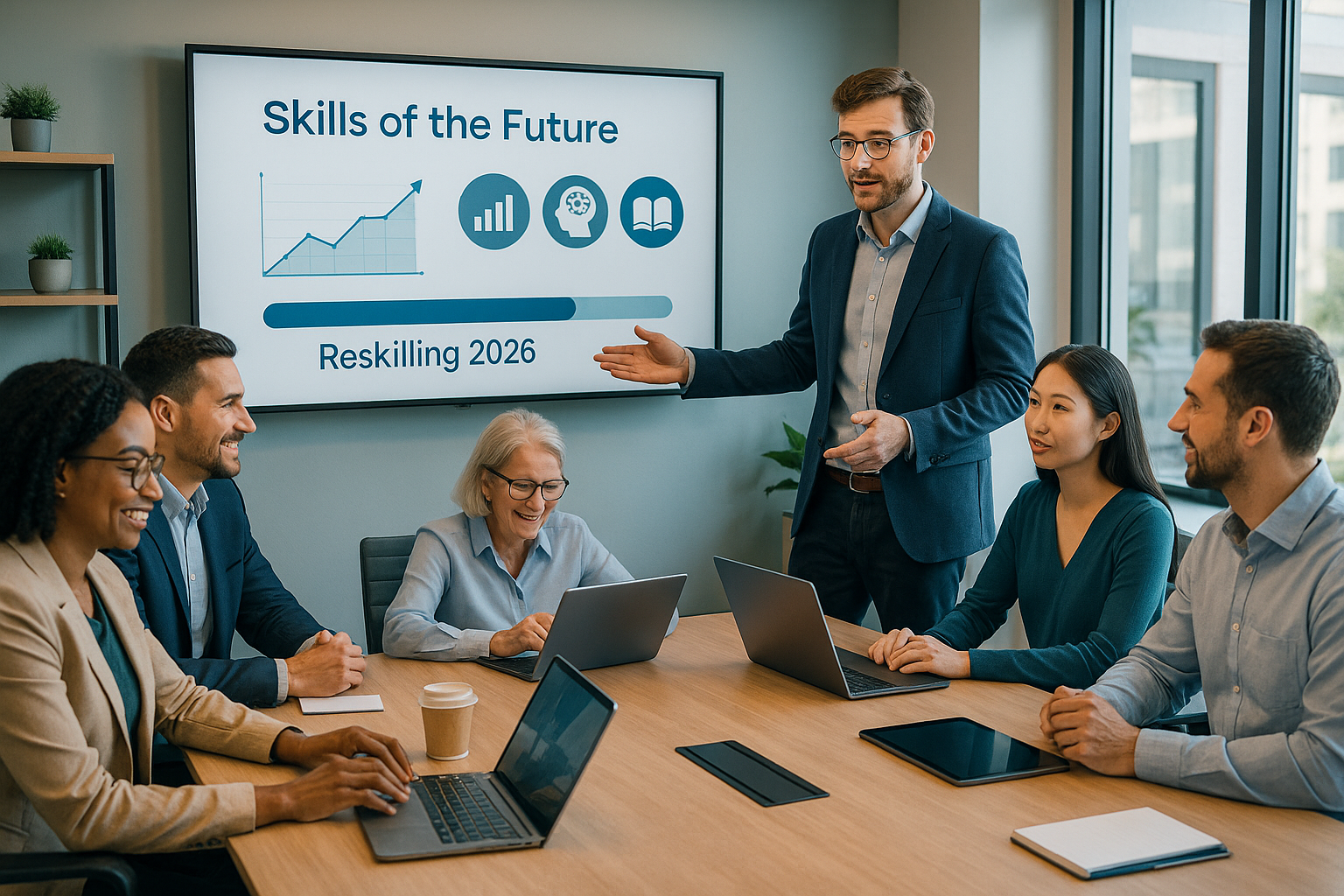
The Best Investment in Leadership and Talent in 2026
In 2026, talent management is no longer just about hiring the right people—it’s about continuously reinventing their skills. The market demands new technological, analytical, and leadership capabilities, while automation and artificial intelligence reshape job roles. In this context, strategic reskilling has become the key lever to retain talent, build more resilient teams, and accelerate your organization’s growth.
What is strategic reskilling?
Reskilling means training your collaborators in new competencies demanded by the business, beyond their current role. It’s not a one‑off course, but an intentional, continuous learning plan that connects individual development with organizational goals.
When designed strategically, reskilling aligns three components:
• Critical capabilities for the future of the company.
• Each collaborator’s individual potential.
• Tools and time to ensure learning is practical, not just theoretical.
How reskilling strengthens leadership
Modern leadership is about being a growth enabler, not just a results driver. Leaders who promote reskilling:
• Identify which roles and teams are most vulnerable to obsolescence.
• Talk with their teams about their aspirations and offer clear development paths.
• Model continuous learning, sharing their own experiences of adaptation.
In this way, reskilling becomes a driver of engagement and loyalty, where talent feels valued and prepared for the future.
Reskilling and teamwork
When teams learn together, the impact multiplies.
• Communities of practice emerge, where members share new skills (for example, data analytics, digital collaboration, or solution design).
• Trust and synergy grow, because the team develops competencies they then apply in real projects.
• Dependency on a few internal “experts” drops, as more people master key skills.
Teams that learn together also solve challenges together.
How to implement a reskilling program (practical steps)
1. Skills gap diagnosis
Map current competencies and those needed in the next 1–3 years (e.g., applied AI, data analysis, inclusive leadership).
2. Personalized learning paths
Design paths combining: microlearning, short courses, mentorship, and hands‑on projects.
Remember that about 60% of professional development happens on the job, not only in classrooms.
3. Protected time for learning
Define how much weekly or monthly time is dedicated to learning (for example, 4 hours per week).
4. Success metrics
Measure not only course attendance, but:
• Real application of new skills in projects.
• Performance improvement in key areas.
• Retention in critical roles.
Strategic reskilling is not a cost—it’s an investment in the future of leadership and the team. In 2026, organizations that deliberately invest in their people’s growth will also be the ones leading their industries. If your team is learning today, your organization will be leading tomorrow.